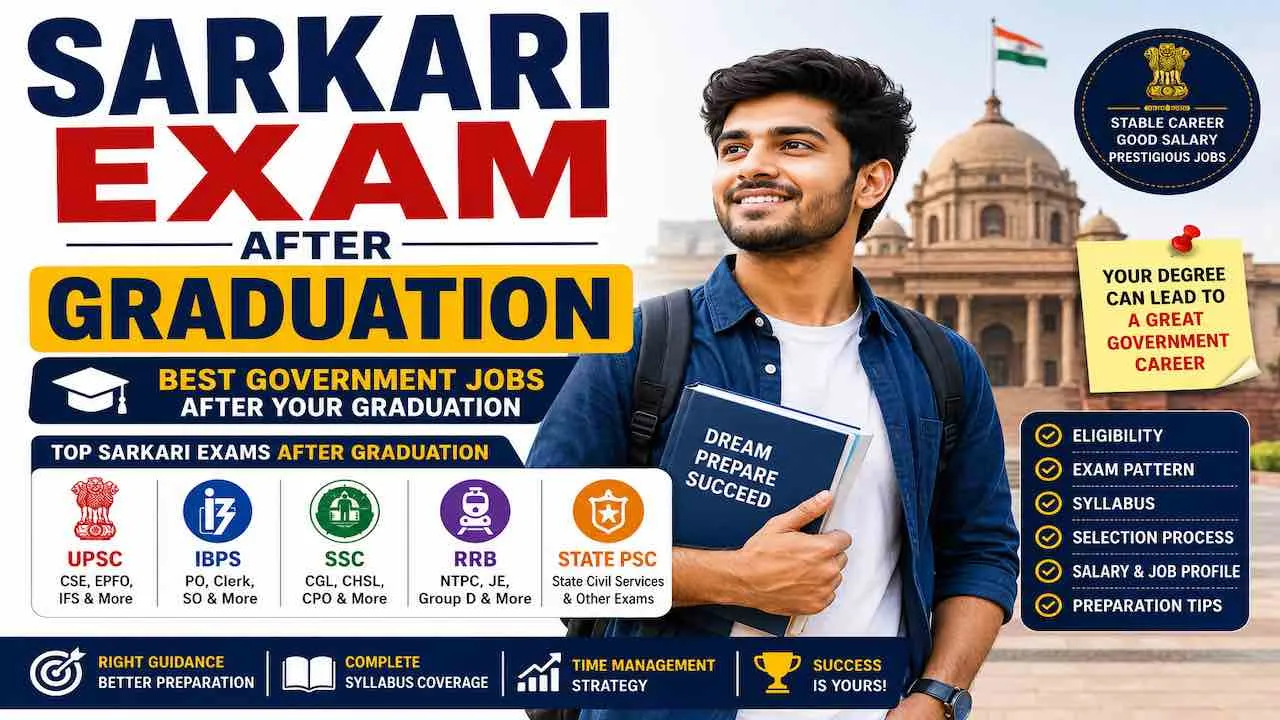
After graduation, you are directly eligible for over 25 major sarkari exams conducted by UPSC, SSC, IBPS, SBI, RBI, RRB, LIC, SEBI and State PSCs. Any bachelor’s degree from a UGC-recognised university qualifies you for most central government exams. Sarkari job after graduation salary ranges from ₹25,500 to ₹2,50,000 per month depending on the exam and post level. The top sarkari exams after graduation are UPSC Civil Services, SSC CGL, IBPS PO, SBI PO, RBI Grade B, RRB NTPC, CDS, and State PSC. This guide on SarkariExam Center covers the complete list of central government exam after graduation and state government exam after graduation options with vacancy data, sarkari exam after graduation salary, eligibility, stream-wise best options for sarkari jobs after BA BSc BCom students, and how to start preparation today.
Why Sarkari Naukri After Graduation Is Still the Best Career Choice
Sarkari naukri after graduation offers 5 measurable advantages over private jobs: job security, higher salary, work-life balance, pension, and career mobility. Nearly 40% of Indian graduates target a secure government job after graduation as the best career option after completing their degree every year, and the reasons are specific and measurable.
- Job security: Government employees cannot be laid off. A permanent sarkari naukri is backed by service rules and pension under NPS.
- 8th Pay Commission salary revision: The The 8th Central Pay Commission has been constituted with salary revisions expected across all government pay levels. Salary revisions are expected to increase government pay by 25 to 30% across all levels. Under the current 7th Pay Commission, salaries already range from ₹25,500 to ₹2,50,000 per month.
- Work-life balance: Fixed working hours, earned leaves, medical facilities under CGHS, and no weekend pressure. A stable life that no private job guarantees at entry level.
- Bank officer after graduation and railway government job options specifically offer the fastest career growth tracks among all sarkari paths.
- Career mobility: Internal promotions, departmental exams, and inter-service transfers allow vertical growth without job-switching.
- Nationwide scope: Central government jobs post you across India with transferable seniority, whereas state jobs offer location stability within your home state.
Top 10 Sarkari Exam After Graduation: Complete List with Vacancies
The top 10 sarkari exams after graduation are UPSC Civil Services, SSC CGL, SBI PO, IBPS PO, RBI Grade B, SEBI Grade A, RRB NTPC, CDS, LIC AAO, and State PSC. All exams require a bachelor’s degree as minimum eligibility. A sarkari exam after any graduation stream, whether BA, BSc, BCom or BCA, qualifies for every exam in this list. Vacancies and salary figures are based on the latest official notifications.
| Exam | Conducting Body | Key Posts | Vacancies | Salary (Month) | Age (General) | Attempts |
|---|---|---|---|---|---|---|
| UPSC Civil Services | UPSC | IAS IPS IFS and 20+ Allied Services | ~1,000 per year | ₹56,100 to ₹2,50,000 | 21 to 32 | 6 (General) |
| SSC CGL | SSC | Inspector, Auditor, Assistant (Group B and C) | 17,000+ per cycle | ₹25,500 to ₹1,51,100 | 18 to 32 | No limit |
| SBI PO | State Bank of India | Probationary Officer | 600 to 2,000 per cycle | ₹77,000 to ₹90,000 | 21 to 30 | 4 |
| IBPS PO | IBPS | Probationary Officer (11 Public Sector Banks) | 4,000 to 5,000 per cycle | ₹52,000 to ₹80,000 | 20 to 30 | No limit |
| RBI Grade B | Reserve Bank of India | Officer Grade B DR | 200 to 400 per cycle | ₹97,000 to ₹1,10,000 | 21 to 30 | 6 |
| SEBI Grade A | SEBI | Officer Grade A General Stream | 120 to 200 per cycle | ₹1,00,000 to ₹1,20,000 | Max 30 | No limit |
| RRB NTPC | Railway Recruitment Board | Station Master, Traffic Assistant, Clerk | 11,000+ per cycle | ₹35,000 to ₹55,000 | 18 to 33 | No limit |
| CDS exam for graduates | UPSC | Army, Navy, Air Force Officer | 400 to 500 per year | ₹56,100 + Military allowances | 19 to 25 | No limit |
| LIC AAO for graduates | LIC India | Assistant Administrative Officer | 300 to 700 per cycle | ₹53,600 to ₹90,000 | 21 to 30 | No limit |
| State PSC (UPPSC, BPSC, GPSC etc.) | State Public Service Commissions | Deputy Collector, DSP, BDO and allied posts | 500 to 5,000 per state | ₹44,900 to ₹1,77,500 | 21 to 40 (state-wise) | State-specific |
IBPS PO alone releases 4,000 to 5,000 vacancies every cycle, making it the highest-vacancy officer-level bank exam after graduation. For a ranked list by salary, see our guide on top 10 high-paying sarkari exams.
SSC CGL vs IBPS PO After Graduation: Which Is Better for You
SSC CGL suits candidates who want ministry posting with 17,000+ vacancies, while IBPS PO suits candidates who prefer banking with 4,000 to 5,000 vacancies and faster promotion. Both require any bachelor’s degree. The right choice depends on your work preference, not just salary.
| Parameter | SSC CGL | IBPS PO |
|---|---|---|
| Conducting Body | Staff Selection Commission | Institute of Banking Personnel Selection |
| Key Posts | Inspector Income Tax, Auditor, Assistant | Probationary Officer in 11 public banks |
| Salary | ₹25,500 to ₹1,51,100 (post-specific) | ₹52,000 to ₹80,000 gross |
| Vacancies | 17,000+ per cycle | 4,000 to 5,000 per cycle |
| Exam Stages | Tier 1, Tier 2, Skill Test | Prelims, Mains, Interview |
| Work Type | Ministry and department posting, desk and field work | Branch banking, customer handling, targets |
| Transfer | Pan-India transfers common | Within bank circles, more predictable |
| Promotion Speed | Department-based, slower in some posts | Performance-linked, faster in active banks |
| Best for | Those who prefer government ministry culture | Those comfortable with targets and banking |
Choose SSC CGL if you want higher vacancies, ministry-level posting, and no sales target pressure. Choose IBPS PO if you want faster career growth, higher starting salary, and prefer a banking environment.
Sarkari Exam After Graduation Stream-wise: BA BSc BCom Best Options
Government jobs for graduates of every stream are available across all exam categories. Most central government exams accept any degree. But matching your stream to the right exam shortens your preparation time measurably.
Sarkari Exam After Graduation for BA Students
BA graduates have the widest options because UPSC GS Papers, SSC CGL General Studies and Banking General Awareness all reward humanities knowledge directly.
- UPSC Civil Services: GS Paper 1 History, Art and Culture and Geography directly align with BA curriculum. BA students score highest in Essay and Ethics papers among all streams.
- SSC CGL after graduation: 17,000+ vacancies, Inspector and Auditor posts with ₹44,900 starting salary. Reasoning and General Awareness sections favour BA graduates.
- Bank PO after graduation: IBPS PO and SBI PO accept any degree. 4,000 to 5,000 IBPS PO vacancies released every year.
- State PSC: UPPSC PCS, BPSC, RPSC. Regional and vernacular knowledge from BA History, Political Science, or Sociology gives direct advantage in Mains papers.
Sarkari Exam After Graduation for BSc Students
BSc graduates outperform other streams in quantitative aptitude sections and hold an additional advantage in science-based government posts.
- UPSC Civil Services: BSc graduates can choose Geography, Physics, Chemistry, Botany, or Zoology as optional paper. Direct degree overlap cuts optional preparation time by 40 to 50%.
- Railway exam after graduation: RRB NTPC Station Master and Traffic Assistant posts suit BSc graduates. 11,000+ vacancies per cycle.
- Defence exam after graduation: CDS exam for graduates and AFCAT (AFCAT eligibility: 60% graduation required) are strong options. BSc Physics and Mathematics holders are preferred for Air Force Flying Branch.
- RBI Grade B: Strong quantitative section performance from BSc background helps in Phase 1 cutoff clearance.
Sarkari Exam After Graduation for BCom Students
BCom graduates hold a direct advantage in finance and accounts-based sarkari exams where knowledge tested in Phase 2 directly mirrors BCom curriculum.
- RBI Grade B: Phase 2 Finance and Management paper aligns with BCom syllabus. Salary ₹97,000+ per month. RBI Grade B eligibility: any graduation with 60% marks, age 21 to 30 years.
- SEBI Grade A: General Stream and Securities Law Stream both favour BCom graduates. Salary ₹1,00,000 to ₹1,20,000 per month.
- Teaching exam after graduation: CTET (with B.Ed) and State TET exams offer teacher posts with salary ₹35,400 to ₹1,12,400 per month.
- UPSC EPFO APFC: Accountancy and Labour Laws papers are directly covered in BCom. Salary Level 10 (₹56,100 to ₹1,77,500 per month).
- SSC CGL Auditor and AAO posts: BCom gives natural advantage in quantitative aptitude, pushing section cutoff clearance easier.
PSU Jobs After Graduation: GATE Route for Engineers
PSU jobs after graduation are available for engineering graduates through GATE score-based recruitment by ONGC, BHEL, NTPC, IOCL, HPCL and other Public Sector Undertakings. This is the highest-paying government job route available to BTech and BE graduates.
- Eligibility: Engineering graduation (BE, BTech) in the relevant discipline with a valid GATE score. Some PSUs also recruit through direct written test without GATE.
- Salary: ₹60,000 to ₹1,80,000 per month CTC including Variable Pay, PF, Gratuity and Perquisites. This is higher than most IAS-level posts at the same service year.
- Top PSU recruiters via GATE: ONGC, BHEL, NTPC, IOCL, HPCL, GAIL, Coal India, BPCL, Power Grid and AAI.
- Non-GATE PSU recruitment: BCA and BTech graduates can also appear for IBPS SO IT Officer post (salary ₹36,000 to ₹63,840 per month) and Railway JE posts.
Sarkari Exam After Graduation: Age Limit and Eligibility
Any bachelor’s degree from any stream qualifies you for most central government sarkari exams after graduation. The sarkari exam after graduation age limit varies by exam and category as shown below.
| Exam | Degree Required | General Age | OBC | SC/ST | Minimum Marks |
|---|---|---|---|---|---|
| UPSC Civil Services after graduation | Any graduation | 21 to 32 | 21 to 35 | 21 to 37 | No minimum |
| SSC CGL eligibility graduation | Any graduation | 18 to 32 | 18 to 35 | 18 to 37 | No minimum |
| IBPS PO eligibility bachelor degree | Any graduation | 20 to 30 | 20 to 33 | 20 to 35 | No minimum |
| RBI Grade B eligibility | Any graduation | 21 to 30 | 21 to 33 | 21 to 35 | 60% in graduation |
| RRB NTPC graduation | Any graduation (graduate posts) | 18 to 33 | 18 to 36 | 18 to 38 | No minimum |
| CDS exam for graduates | Any graduation (service-specific) | 19 to 25 | No relaxation | No relaxation | No minimum |
| AFCAT eligibility | Any graduation (60% marks) | 20 to 26 | No relaxation | No relaxation | 60% in graduation |
How to Choose the Right Sarkari Exam After Graduation
Choose your sarkari exam after graduation based on 3 factors: your current age window, your degree stream advantage, and the preparation time you can realistically commit. Apply this 4-step framework before registering for any exam.
Step 1: Age Window Decides Your Strategy
- Age 21 to 24: Target UPSC Civil Services as primary with SSC CGL or IBPS PO as simultaneous backup. Maximum attempts available.
- Age 25 to 28: Prioritise SSC CGL, IBPS PO and SBI PO where preparation-to-result cycle is 6 to 12 months. Continue UPSC only if already mid-preparation.
- Age 29 to 32: Focus on UPSC EPFO APFC (max age 35), State PSC exams and SSC CGL where upper age is 32 years for General category.
Step 2: Match Your Stream Advantage
BCom graduates should start RBI Grade B or SEBI Grade A preparation first. BA graduates should target UPSC or SSC CGL. BSc graduates should consider UPSC with a science optional alongside RBI Grade B for banking route.
Step 3: Choose by Preparation Time Available
| Time Available | Target Exam | Why |
|---|---|---|
| Easy sarkari exam after graduation (3 to 5 months) | IBPS Clerk, SSC CHSL, IBPS RRB Clerk | Manageable syllabus, structured pattern, no interview |
| Moderate (6 to 12 months) | SSC CGL, IBPS PO, SBI PO, LIC AAO for graduates | Good salary, annual cycle, broad vacancies |
| High effort (12 to 18 months) | RBI Grade B, SEBI Grade A, NABARD Grade A | Specialist Phase 2, higher salary payoff |
| Full commitment (18 to 30 months) | UPSC Civil Services, State PSC | Highest prestige, IAS IPS career, most competitive |
Step 4: Prepare for 2 Exams Simultaneously
All State PSC exams follow a Prelims Mains Interview pattern. SSC CGL, IBPS PO, RRB NTPC and State PSC exams all share Reasoning, Quantitative Aptitude and General Awareness. Mastering these three sections covers 80% of the preparation requirement for all four exams at once. A government exam after graduation with high salary becomes reachable faster when you combine efforts across overlapping syllabi.
Sarkari Exam Preparation After Graduation: How to Get Sarkari Job After Graduation
Start sarkari exam preparation within 30 days of graduation results to maximise attempts and age window. Knowing how to get sarkari job after graduation starts with a clear plan. Begin within 30 days of final results to avoid losing the age advantage that increases selection probability. Here is the step-by-step starting framework used by successful sarkari job aspirants.
- Fix 1 primary and 1 backup exam first. Preparing for 5 exams simultaneously leads to average scores in all of them. Most government jobs for freshers after graduation are won with focused preparation on 2 exams maximum.
- Sarkari Exam Calendar After Graduation: When to Apply UPSC Civil Services Prelims notifies in February and exam is in May-June. SSC CGL Tier 1 notifies in April and exam is in June-July. IBPS PO Prelims notifies in July and exam is in October. RRB NTPC notifies irregularly with 2 to 3 year gaps between cycles.
- Track notifications: UPSC Prelims is in May-June, SSC CGL Tier 1 runs in June-July, IBPS PO Prelims is in October. Missing a notification means waiting another year. Track the exam calendar of every exam you target.
- Download the official syllabus from the conducting body’s website. SSC.nic.in for CGL, ibps.in for IBPS PO, upsc.gov.in for Civil Services. Build a topic-by-topic study plan from the official document, not from coaching notes.
- Build common subjects first: Reasoning, Quantitative Aptitude and General Awareness are tested in all major sarkari exams after graduation. Spending 60 days on these three subjects alone prepares you for SSC, Banking and Railway exams simultaneously.
- Practice with Computer Based Test mock tests regularly. Every top sarkari exam after graduation runs in CBT mode. Interface familiarity built through mock test practice saves 8 to 12 minutes on exam day that most first-time test-takers lose to navigation confusion. Access exam-specific practice through our complete mock test library.
- Read one newspaper daily for current affairs. General Awareness sections in SSC CGL, Banking and Railway exams pull directly from events of the last 6 months. 20 minutes of daily news reading compounds into a 10 to 15 mark advantage over exam day.
For notifications, syllabus updates, mock tests and recruitment alerts across all sarkari exams after graduation. For a complete day-by-day preparation roadmap, read our guide on how to prepare for sarkari exams.
Sarkari Exam After Graduation: FAQs
UPSC Civil Services is the most prestigious sarkari exam after graduation leading to IAS IPS posts with salary up to ₹2,50,000 per month. For faster results in 6 to 12 months, SSC CGL (17,000+ vacancies) and IBPS PO (4,000 to 5,000 vacancies) are the top choices.
Yes. UPSC, SSC CGL, IBPS PO, SBI PO, RBI Grade B, LIC AAO and RRB NTPC all accept any graduation degree from a UGC-recognised university regardless of stream. Only specialist posts require a specific degree.
Standard age limit is 18 to 32 years for General category. OBC candidates get 3 years extra. SC/ST candidates get 5 years extra. UPSC EPFO allows up to 35 years for General category.
IBPS Clerk, SSC CHSL and RRB NTPC are the easiest sarkari exams after graduation with manageable syllabus and 3 to 5 months of preparation needed. No interview round in IBPS Clerk makes it the simplest entry.
SEBI Grade A (₹1,00,000+) and RBI Grade B (₹97,000+) offer the highest salary for graduation-level government exams outside UPSC. Both are the best high salary government job after graduation targets for BCom and Economics graduates.