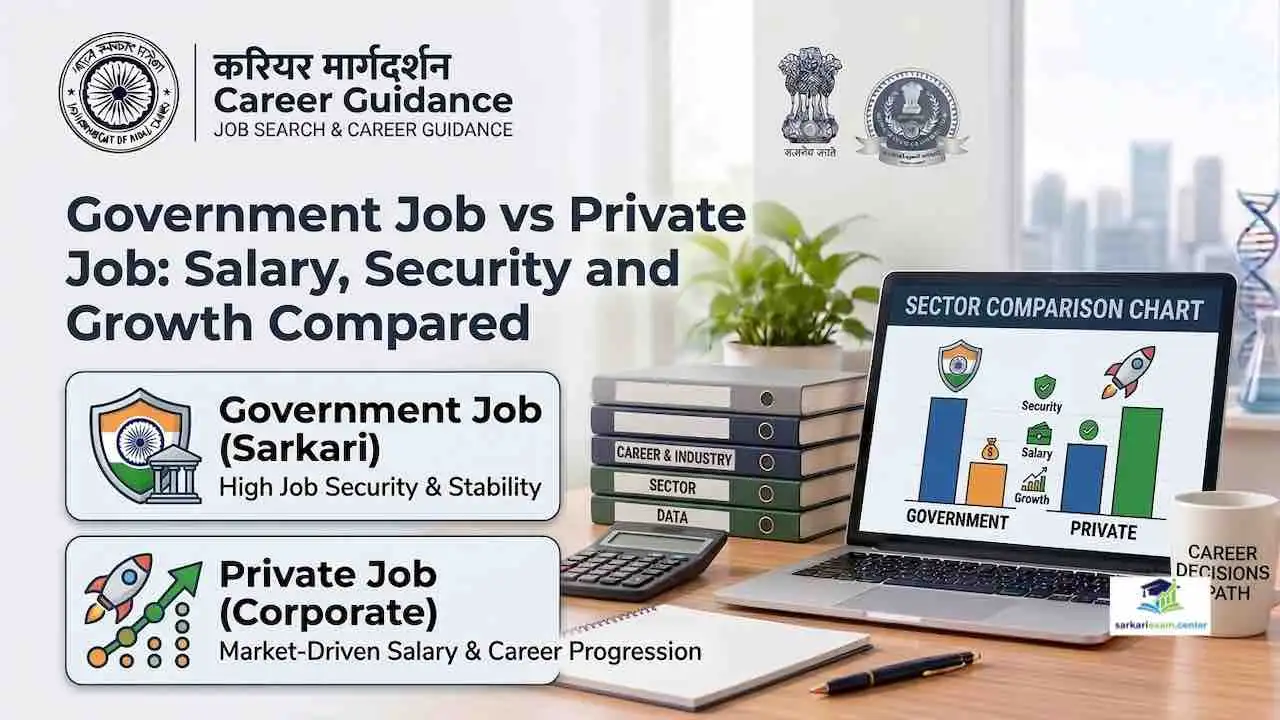
Government job vs private job India का सबसे बड़ा career decision है। Government jobs stability, pension, और constitutional job protection देती हैं। Private jobs faster salary growth, performance bonuses, और rapid career advancement देती हैं। दोनों में से कोई एक universally better नहीं है। सही choice आपके goals, risk tolerance, और lifestyle पर depend करती है। इस article में salary, job security, benefits, growth, और work-life balance सभी factors का data-driven comparison किया गया है। sarkari exam की तैयारी करने वाले candidates के लिए यह comparison एक informed decision लेने में help करेगा।
Quick Comparison: Government Job vs Private Job एक नजर में
नीचे दी table government और private jobs के 10 major parameters का direct comparison करती है।
| Parameter | Government Job (Sarkari Naukri) | Private Job | Winner |
|---|---|---|---|
| Job Security | Near 100%, Article 311 protection | ~5% annual layoff risk on average | Government |
| Starting Salary | Rs 22,000 से Rs 56,100 (Level 1 to 10) | Rs 20,000 से Rs 60,000+ (role dependent) | Tie (level dependent) |
| Salary Growth | 3% annual increment + DA revision twice yearly | 10% से 30% annual hike (performance based) | Private |
| Retirement Benefits | NPS pension + Gratuity + PF | EPF + Gratuity (after 5 years) | Government |
| Medical Benefits | CGHS (lifetime coverage including family) | Group health insurance (company dependent) | Government |
| Work-Life Balance | Fixed hours, 20+ holidays, generous leave | Variable hours, project pressure, fewer holidays | Government |
| Career Growth Speed | Seniority-based, slow promotion | Performance-based, fast promotion possible | Private |
| Perks और Allowances | HRA, DA, TA, LTC, CEA, CGHS, housing | Variable pay, ESOPs, performance bonus | Government (stability), Private (upside) |
| Social Status | High respect, marriage prospects better | Growing but still lower than IAS/IPS | Government (traditional society) |
| Skill Development | Limited, role stays similar for years | Continuous learning, new technologies | Private |
Salary Comparison: Government Job vs Private Job
Government jobs में salary structured aur predictable होती है jabki private jobs में salary role, company, aur performance par depend karti hai। Entry level par dono mein salary comparable ho sakti hai lekin mid-career par private sector significant lead le sakta hai।
Government Job Salary Structure (7th Pay Commission)
| Post Category | Pay Level | Basic Pay (Starting) | DA (53% of Basic) | Approximate Gross |
|---|---|---|---|---|
| Group D (Railway, MTS) | Level 1 | Rs 18,000 | Rs 9,540 | Rs 35,000 से 40,000 |
| Clerk, LDC, Constable | Level 2 से 4 | Rs 19,900 से 25,500 | Proportionate | Rs 38,000 से 50,000 |
| SSC CGL Group B, IBPS Clerk | Level 4 से 6 | Rs 25,500 से 35,400 | Proportionate | Rs 50,000 से 65,000 |
| IBPS PO, SSC CGL Group B (Gazetted) | Level 7 से 8 | Rs 44,900 से 47,600 | Proportionate | Rs 75,000 से 85,000 |
| UPSC IAS/IPS/IFS (Entry) | Level 10 | Rs 56,100 | Rs 29,733 | Rs 1,00,000 से 1,20,000 |
Government salary में DA (Dearness Allowance) हर 6 महीने में revise होता है। Current DA central government employees के लिए basic pay का 53% है। 8th Pay Commission approved हो चुका है जो salary structures revise करेगा। HRA metro cities में basic pay का 27%, Y cities में 18%, और Z cities में 9% होता है।
Private Job Salary Structure
| Level | Role Examples | Typical CTC Range | In-hand Salary (Approx) |
|---|---|---|---|
| Fresher (0 से 1 साल) | IT Engineer, MBA Trainee, BPO Executive | Rs 2.5 से 8 LPA | Rs 18,000 से 55,000/month |
| Junior (2 से 4 साल) | Software Developer, Marketing Executive | Rs 5 से 15 LPA | Rs 35,000 से 1,00,000/month |
| Mid-Level (5 से 8 साल) | Senior Engineer, Team Lead, Manager | Rs 12 से 35 LPA | Rs 80,000 से 2,50,000/month |
| Senior (10+ साल) | Principal Engineer, AVP, Director | Rs 30 से 1 crore+ LPA | Rs 2 से 8+ lakh/month |
Private sector में salary ceiling unlimited है लेकिन यह performance, company growth, और market conditions पर depend करती है। Government sector में salary predictable है लेकिन ceiling limited है। Entry level पर comparison close होती है। Senior level पर private sector significantly आगे निकल सकता है।
Job Security: Government Job ka Sabse Bada Advantage
Job security government job का सबसे strong advantage है। Constitution का Article 311 permanent government employees को arbitrary dismissal, removal, या demotion से protect करता है। किसी भी government employee को formal departmental inquiry और tribunal review के बाद ही dismiss किया जा सकता है।
- Government Job Security: Near 100% job security। Economic recession, market crash, या company loss का कोई directly effect नहीं। Railway, Postal, और other unionized sectors में additional collective bargaining protection। Retirement age 60 साल fix है।
- Private Job Security: ~5% annual layoff risk on average। Economic downturns में large-scale job cuts। Tech sector में global layoffs एक सामान्य pattern बन चुका है। Performance, company profitability, और market conditions पर directly dependent।
Private job में uncertainty emotional और financial दोनों तरह से stress देती है। Mortgage, family planning, और long-term financial decisions government job में आसान होते हैं।
Benefits aur Perks: Government Job ka Comprehensive Package
Government job का total compensation package salary से कहीं ज्यादा होता है। Benefits और perks को जोड़ने पर government job का actual value private job से कम नहीं बल्कि कई cases में ज्यादा होता है।
| Benefit | Government Job | Private Job |
|---|---|---|
| Dearness Allowance (DA) | Basic pay का 53% (inflation के साथ बढ़ता है) | नहीं (salary hike में merge होता है) |
| House Rent Allowance (HRA) | Basic pay का 9% से 27% (city category) | Basic का 40% से 50% (usually CTC में included) |
| Medical Coverage | CGHS: Self + family, lifetime validity (even post-retirement) | Group Insurance: Rs 3 से 5 lakh typically, employment तक valid |
| Leave Travel Concession (LTC) | हाँ, हर 4 साल में rail/air travel reimbursement | कुछ companies offer करती हैं, most नहीं |
| Children Education Allowance | हाँ, Rs 2,812 प्रति child प्रति month | नहीं |
| Pension | NPS (post-2004 recruits): Government + employee contribution | EPF: 12% employee + 12% employer (capped at Rs 15,000 basic) |
| Gratuity | Maximum Rs 20 lakh | 15 days salary × years of service (after 5 years minimum) |
| Annual Leave | 30 EL + 8 CL + 20 HPL (Earned, Casual, Half Pay Leave) | Typically 15 से 24 days total |
| Public Holidays | Gazetted 17 + Restricted Holidays 2 | 10 से 14 typical (company policy) |
| Job Continuity | Permanent post, no retrenchment | At-will employment in most cases |
Career Growth: Private Job Mein Faster, Government Mein Stable
Private job में career growth performance-linked और fast होता है, jabki government job में growth seniority-based aur predictable hota hai।
Government Job mein Promotion Structure
- Promotion primarily seniority-based होती है।
- DPC (Departmental Promotion Committee) द्वारा fixed intervals पर review।
- IAS/IPS में clear service grade structure होती है: SDM, District Collector, DIG, IG, and above।
- IBPS PO से Branch Manager और Regional Manager तक promotion structured है।
- Outstanding performance से promotion fast हो सकती है लेकिन guarantee नहीं है।
- Political influence और departmental dynamics promotion को affect कर सकते हैं।
Private Job mein Promotion Structure
- Performance appraisal cycle typically annual होता है।
- Outstanding performer 2 से 3 साल में promotion पा सकता है।
- Job change से salary 30% से 50% तक एक jump में बढ़ सकती है।
- MNCs और startups में ESOP (Employee Stock Options) से wealth creation possible।
- Skill-based lateral movement और career switch आसान होता है।
- लेकिन restructuring, company loss, या market change में promotion रुक सकती है।
Work-Life Balance: Sarkari Job Clearly Better Hai
Government job में work-life balance private job से significantly बेहतर होता है। Fixed working hours, generous leave policy, और job pressure की अनुपस्थिति government employees को personal life के लिए time देती है।
| Factor | Government Job | Private Job |
|---|---|---|
| Working Hours | Fixed: typically 9 AM से 5:30 PM (5 days or 6 days) | Variable: 9 से 12 hours common, project deadlines में अधिक |
| Weekend Work | Rarely required | Common in IT, banking, consulting |
| Work Pressure | Low to moderate | High, performance targets हमेशा होते हैं |
| Vacation | 30 Earned Leaves + 8 Casual Leaves annually | 15 से 24 days typically |
| Mental Stress | Low (job security eliminates financial anxiety) | High (layoff fear, performance pressure) |
| Family Time | More consistent | Less predictable |
Retirement Benefits: Pension vs EPF ka Comparison
Retirement के बाद financial security government job में clearly better है। Government employees को NPS, Gratuity, और CGHS का combined benefit मिलता है। Private employees EPF और personal savings पर dependent रहते हैं।
- Government NPS (New Pension Scheme): Employee: basic pay + DA का 10% contribute करता है। Government: 14% contribute करती है। Retirement पर accumulated corpus से monthly pension मिलती है। Post-retirement CGHS medical coverage family के लिए continue करती है।
- Old Pension Scheme (OPS): Pre-2004 recruits के लिए applicable। Last drawn salary का 50% guaranteed pension। DA revision pension पर भी apply होती है। कुछ state governments OPS restore कर रही हैं।
- Private EPF: Employee और employer दोनों basic salary का 12% contribute करते हैं। EPFO (Employees’ Provident Fund Organisation) manage करता है। Retirement पर lump sum मिलता है। Monthly pension के लिए NPS या personal investment जरूरी है।
Transfer Policy: Government Job ka Ek Real Challenge
Government job में transfer policy एक significant disadvantage है जिसे candidates अक्सर underestimate करते हैं।
- Central Government employees को anywhere in India post किया जा सकता है।
- IAS, IPS, IFS officers को cadre state में posting मिलती है जो home state से अलग हो सकती है।
- Railways, Defence, और central departments में remote postings common हैं।
- Family separation और children की schooling affect होती है।
- State Government jobs में transfer typically same state के अंदर होती है।
- Private jobs में transfer आमतौर पर consent-based होती है।
- WFH (Work From Home) और hybrid models private sector में increasingly common हैं।
Social Status aur Marriage Prospects: Reality Check
India के traditional society में government job का social status private job से अधिक है। यह gap urban और educated families में कम हो रहा है लेकिन tier-2 और tier-3 cities में government job का respect clearly higher है।
- IAS, IPS, और other Class I officers को highest social respect मिलता है।
- Government employees के लिए marriage proposals traditionally अधिक और better आते हैं।
- Parents की preference typically government job की तरफ होती है।
- Private sector में IT और MNC professionals का status growing है।
- Startup founders और senior corporate executives को modern urban society में equal or higher status मिलने लगा है।
- Rural और semi-urban families में government job की preference significantly stronger है।
Kab Government Job Choose Karein, Kab Private Job
Government job या private job का decision आपके personal priorities पर depend करता है। नीचे दिया framework आपको informed choice लेने में help करेगा।
| अगर आपकी Priority है… | Government Job Choose करें | Private Job Choose करें |
|---|---|---|
| Financial Security | Guaranteed salary, pension, lifetime CGHS | Higher salary potential, ESOPs, bonuses |
| Job Certainty | Near 100% job security, Article 311 protection | Performance-based, market-dependent |
| Fast Career Growth | Slow और structured | Performance से fast, job change से faster |
| Work-Life Balance | Fixed hours, generous leave | Variable, project-dependent |
| Skill Development | Limited in most departments | Continuous learning, new technologies |
| Maximum Income Potential | Capped by pay commission | Unlimited ceiling |
| Location Flexibility | Government transfers होती हैं | Generally consent-based, WFH possible |
| Risk Tolerance Low है | Government job suited है | Private job में risk है |
| Entrepreneurial Mindset है | Government में creativity limited | Private sector better platform है |
High-paying government exams की list देखने के लिए top 10 high-paying sarkari exams पढ़ें। IBPS banking exams और corporate job के बीच detailed comparison के लिए corporate job vs IBPS comparison देखें। Government exam की तैयारी शुरू करना है तो sarkari exam preparation guide से strategy जानें।
Government Job vs Private Job: Aksar Puche Jane Wale Sawal
Entry level par dono comparable hain lekin mid aur senior level par private jobs salary mein aage nikal jaati hain। IBPS PO ka gross Rs 80,000/month hai jabki ek senior IT professional Rs 2 se 5 lakh/month kama sakta hai। Lekin government job ka total compensation benefits milane par comparable hota hai: DA, HRA, CGHS, LTC, pension, aur gratuity sab mile kar package ko significant bana dete hain।
Permanent government employees ke liye job security near 100% hai. Constitution ka Article 311 arbitrary dismissal se protect karta hai। Formal departmental inquiry ke bina kisi bhi confirmed government employee ko dismiss nahi kiya ja sakta। Lekin contractual, temporary, aur probationary government employees ko yeh protection nahi milti। Probation period (typically 2 saal) mein bhi kuch risk hota hai।
Private job mein EPF (Employees’ Provident Fund) aur Gratuity milti hai। EPF mein employee aur employer dono basic pay ka 12% contribute karte hain। Gratuity ke liye minimum 5 saal ki service zaruri hai। Monthly pension ke liye NPS ya personal investments zaruri hain। ESOP ya stock holdings bhi retirement wealth mein contribute karte hain। Government job ki guaranteed monthly pension jaisi security private mein nahi hoti।
Work-life balance mein government job clearly better hai। Fixed working hours (9 AM se 5:30 PM), 30 earned leaves, 8 casual leaves, aur 17 gazetted holidays government employees ko milte hain। Private jobs mein 9 se 12 hour work days, weekend pressure, aur limited leave typical hai। IT sector mein WFH aur flexibility badhti ja rahi hai lekin pressure bhi high hai।
Fresher ke liye choice career goal par depend karti hai। Stability, family pressure, aur long-term security chahiye to government job target karein। Fast career growth, skill development, aur high earning potential chahiye to private join karein। Ideal approach: graduation ke baad 2 se 3 saal private job mein kaam karein aur government exams ki parallel preparation karein। Yeh dono ka best use karne ka strategy hai।